
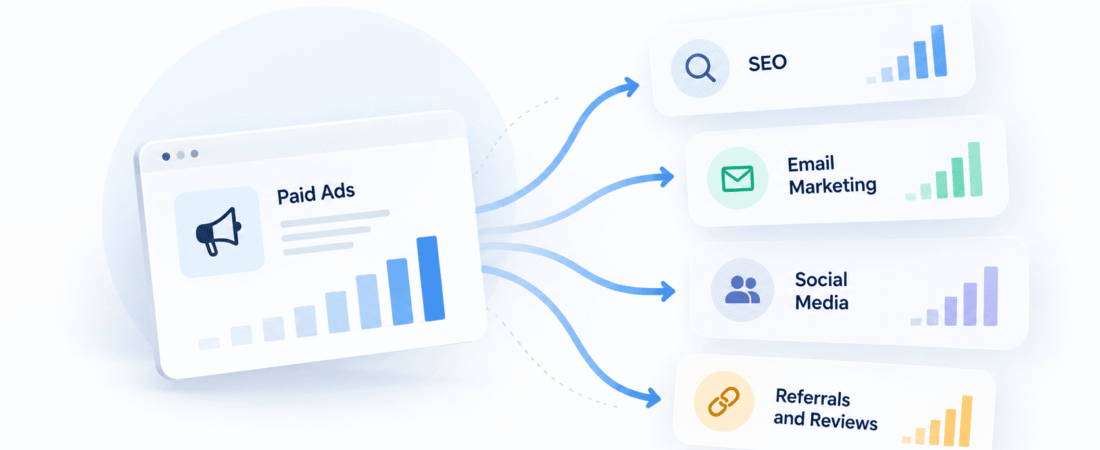
Are Facebook ads getting too expensive? Google Ads costs eating into your margins? Or maybe your campaigns are still generating sales, but you know those sales could disappear as soon as you stop spending.
The problem isn’t necessarily paid advertising itself. It’s when your business has no reliable way to acquire customers without it.
Reducing dependence on paid ads requires two things: building alternative customer acquisition channels and knowing when those channels are strong enough to support your business.
Here’s how to approach both without putting your existing revenue at unnecessary risk.
How to Gradually Reduce Dependence on Paid Ads Without Losing Sales
Reducing advertising dependence doesn’t mean switching off campaigns and hoping organic traffic will make up the difference.
A more practical approach is to understand your current acquisition costs, build alternative channels, and gradually test where paid spending can be reduced.
Step 1: Understand Where Your Customers Come From
Before changing your advertising budget, establish a baseline using the past three to six months of performance.
Start with these metrics:
| Metric | Why It Matters |
| Total revenue and contribution profit | Shows whether the business is becoming more profitable. |
| Advertising spend and customer acquisition cost (CAC) | Helps measure the cost of acquiring new customers. |
| Paid revenue share | Tracks the percentage of total revenue attributed to paid advertising. A declining share may suggest that other channels are contributing more, but doesn’t necessarily mean ads are less important. |
| New customers by acquisition channel | Identifies which channels contribute to customer growth. |
| Organic leads, orders, and revenue | Shows whether unpaid channels generate business, not just traffic. |
| Repeat purchase rate and returning customer revenue | Measures revenue generated from existing customers. |
Pay attention to attribution. Someone might discover your brand through a Facebook ad, then return through organic search to make a purchase. Depending on your attribution model, organic search may receive some or all of the conversion credit.
For example, if paid advertising’s share of total revenue falls from 80% to 60% while overall revenue grows, that’s worth investigating. But it doesn’t necessarily mean paid ads have become less important, since they may still influence purchases attributed to other channels.
Use Google Search Console to compare branded and nonbranded search performance, then check GA4, Shopify, or your CRM for conversions and new customer data.
These reports won’t tell you exactly which channel caused every purchase, but they can help you understand your customer acquisition mix before deciding what to cut.
Step 2: Build Alternative Customer Acquisition Channels
SEO, organic social media, email marketing, and referrals can all help reduce advertising dependence. But they serve different purposes.
| Channel | Primary Role |
| SEO | Capture existing search demand |
| Organic Social Media | Build awareness and generate demand |
| Email Marketing | Convert leads and encourage repeat purchases |
| Referrals and Reviews | Generate recommendations and build trust |
Some channels attract new customers. Others help generate more revenue from customers you already have. That distinction matters when deciding where to invest.
1. SEO
SEO helps businesses reach customers who are already searching for their products or services on Google, without paying for every click.
A well-optimized product or category page can continue attracting customers long after it’s published. However, SEO takes time, requires investment, and doesn’t guarantee rankings or sales.
Is SEO Right for Your Business?
One practical way to evaluate SEO potential is to use Semrush or Ahrefs to research whether customers search for relevant topics throughout their buying journey.
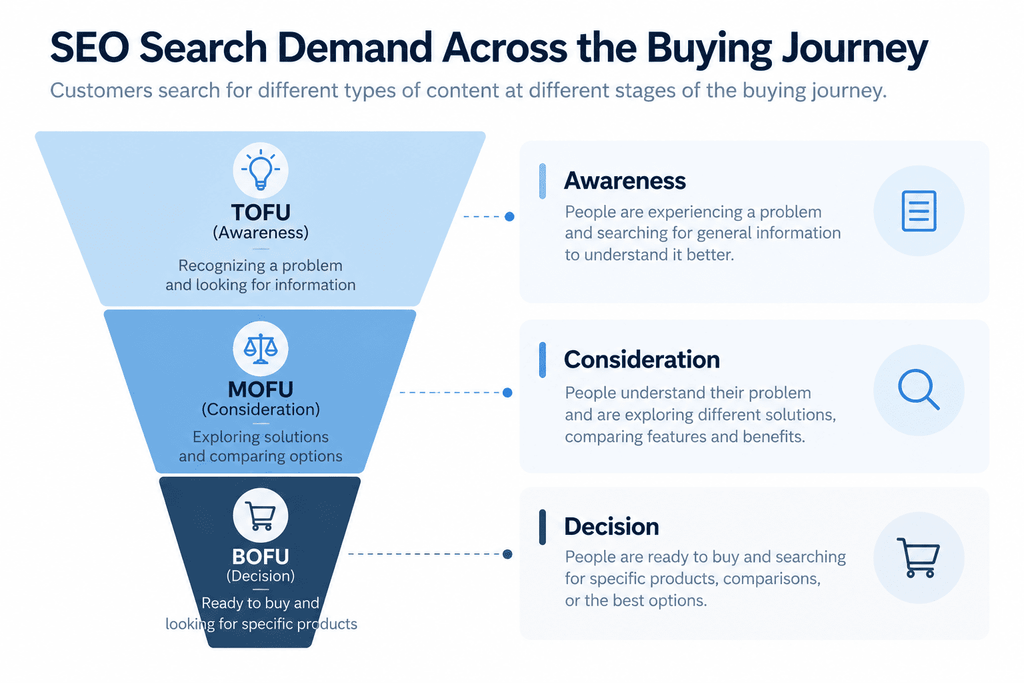
If relevant keywords exist across all three stages, it’s a good sign that customers use search throughout their buying journey. Pay particular attention to commercial keywords and whether your business can realistically compete for them.
However, if you’re selling a new product category that customers aren’t familiar with, search demand may be limited. Social media or creator content could be more effective initially because they help introduce the product and explain its value before people actively search for it.
SEO can amplify a good product, but it can’t make customers want something they don’t need.
2. Organic Social Media
Not every customer starts their buying journey with a Google search. Social media can help people discover products, learn about brands, and develop interest before they actively look for something to buy.
Different platforms offer different opportunities:
| Platform | Best Suited For | Organic Content Opportunities |
| B2B, SaaS, consulting, professional services | Industry insights, case studies, expert opinions, founder content | |
| Fashion, beauty, fitness, home decor, lifestyle brands | Reels, product demonstrations, customer content | |
| Local businesses, community-driven brands, consumer services | Groups, local communities, customer stories, events | |
| Home decor, furniture, fashion, beauty, weddings, DIY | Room inspiration, styling guides, tutorials, product collections | |
| YouTube | Software, electronics, home appliances, education, complex products | Tutorials, product reviews, comparisons, demonstrations |
| TikTok | Beauty, fashion, food, fitness, lifestyle products | Short videos, demonstrations, tutorials, creator content |
Is Organic Social Media Right for Your Business?
Start by researching three to five competitors with a similar target audience.
Look at which platforms they prioritize, what content consistently performs well, and whether they’re directing audiences toward product pages or other conversion opportunities.
You can use Meta Ad Library to check whether competitors are running Facebook or Instagram ads. Similarweb can also provide estimates of social referral traffic.
If several competitors perform well on the same platform, that’s a useful signal that your audience may be there. But consider whether you have the resources to produce similar content and whether that attention can translate into qualified leads or sales.
Organic social media doesn’t always deliver predictable reach or consistent sales. Paid advertising can still complement your organic efforts, especially for product launches or reaching specific audiences.
3. Email Marketing
Email marketing is particularly useful for converting interested prospects and encouraging repeat purchases. It won’t necessarily replace paid advertising as a source of new customers, but it can help you generate more revenue from existing relationships.
| Business Type | Email Opportunities |
| B2C / Ecommerce | Welcome emails, abandoned checkout reminders, product recommendations, replenishment reminders, loyalty offers |
| B2B / Services | Educational content, case studies, industry insights, webinar invitations, follow-ups |
If you already have customers or engaged subscribers, email marketing may offer a faster opportunity to improve revenue than building an entirely new acquisition channel.
Start with a permission-based subscriber list and basic email sequences. As your audience grows, use segmentation and customer behavior to improve conversion and retention.
Track repeat purchase rates, customer lifetime value, and returning customer revenue to evaluate whether your email efforts are contributing to business growth.
4. Referrals and Reviews
Referrals can help businesses acquire customers through existing relationships, while reviews help potential buyers evaluate whether a business is trustworthy.
| Business Type | Referral Opportunities | Review Strategy |
| B2B / Professional Services | Ask satisfied clients for introductions and build referral partnerships. | Collect testimonials and case studies with specific results. |
| B2C / Ecommerce | Offer referral rewards and encourage customer recommendations. | Request honest product reviews after delivery. |
| Local Businesses | Encourage word of mouth and build relationships with nearby businesses. | Maintain a Google Business Profile and invite genuine customer reviews. |
For example, a web design consultant could ask a satisfied client whether they know another business planning a website redesign. An ecommerce brand could offer existing customers a referral discount for introducing a friend.
Make referrals easy with clear instructions or referral codes. For Google reviews, request genuine feedback without offering rewards or selectively asking only for positive reviews.
Referrals are difficult to scale predictably, especially with a small customer base. They’re best treated as an additional acquisition source rather than your only alternative to paid advertising.
Step 3: Identify Paid Campaigns Worth Reducing
Once you’ve started building alternative channels, review which paid campaigns are actually contributing profitable customers.
Don’t automatically start by cutting the most expensive campaign. Look for campaigns with weak contribution margins, questionable incremental value, or poor conversion performance after reasonable optimization.
| Campaign Type | What to Consider |
| Branded search ads | If you rank first organically for your brand, test whether reducing ads affects total sales. |
| Nonbranded search ads | Be cautious when campaigns acquire profitable customers through commercial keywords you don’t rank for organically. |
| Prospecting campaigns | Consider whether they introduce new customers who later convert through other channels. |
| Retargeting campaigns | Check whether they generate additional purchases or receive credit for customers who were already likely to return. |
If Google Ads costs are high because a landing page converts poorly, improving the page may be more sensible than stopping the campaign.
Likewise, an impressive ROAS doesn’t necessarily mean a campaign is generating additional sales. Some customers might have purchased without seeing the ad.
A 2026 case study published by Search Engine Land found that organic and direct revenue partially recovered after a business paused paid search ads.
While the results don’t prove that the ads were unnecessary, they show why attributed revenue alone isn’t enough to judge a campaign’s value. Testing whether the ads generate additional sales is more useful.
Step 4: Test a Gradual Reduction in Ad Spend
Suppose an ecommerce business spends $10,000 per month on advertising.
Its SEO traffic has grown, email generates repeat purchases, and some campaigns appear less profitable than others.
The business identifies a campaign spending $2,000 per month that may have limited incremental value.
Rather than switching it off immediately, it tests a reduction in spending while keeping other major marketing activities as stable as possible.
A geographic experiment with comparable markets or another suitable control group can provide stronger evidence than simply comparing performance before and after the change.
If a controlled experiment isn’t feasible, use a carefully monitored reduction and recognize that the results will be less conclusive.
Here’s a hypothetical example of what a gradual reduction in ad spend might look like.
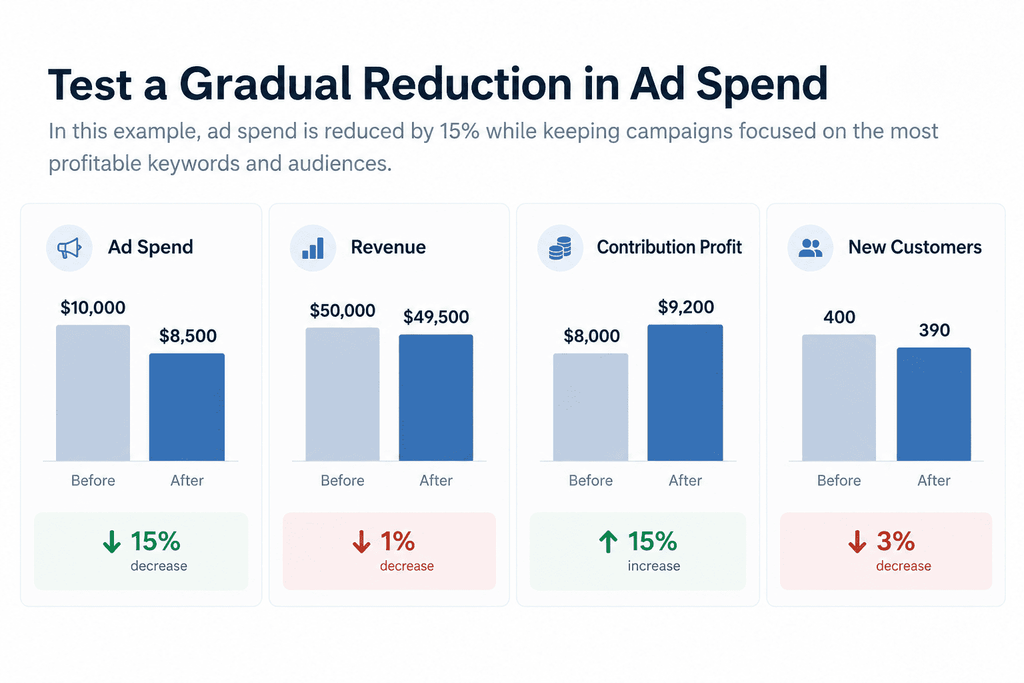
In this example, advertising spend falls by $1,500, revenue declines by $500, and contribution profit increases by $1,200.
This could be a worthwhile trade-off if the business can tolerate the small reduction in new customers and the potential impact on future revenue.
However, one month’s results don’t establish causation. Seasonality, promotions, conversion delays, and other marketing activities can affect performance. Businesses should also consider whether reduced customer acquisition could affect future revenue.
The goal isn’t to replace every paid click with an organic one. It’s to find out how much advertising you can remove without losing profitable customers.
Step 5: Reinvest and Adjust Based on Results
Reducing ad spend doesn’t mean all the savings should immediately go into SEO or social media.
Invest where you see the strongest opportunities. That might mean improving commercial pages already attracting qualified organic traffic, building email retention campaigns, or optimizing landing pages with poor conversion rates.
After each reduction, monitor total revenue, contribution profit, and new customer acquisition.
If results remain healthy, you may have room to reduce spending further. If sales or new customer acquisition decline significantly, investigate before making additional cuts.
There is no universal percentage of advertising spend that every business should remove. The decision should depend on actual business performance and expected returns.
Should You Pause Google Ads Completely?
You don’t need to stop running Google Ads entirely to reduce your advertising costs. Focus on individual campaigns instead.
Consider reducing or pausing campaigns when:
- They remain unprofitable after reasonable optimization.
- Controlled tests show they add little incremental revenue or profit.
- Strong organic rankings and sales suggest overlapping demand worth testing.
Keep profitable campaigns running, especially when they consistently acquire new customers or your organic visibility is weak for important commercial searches.
The same applies to Facebook Ads. If costs are rising, review campaign profitability, audience saturation, and landing page performance before deciding to stop advertising entirely.
Conclusion
Reducing dependence on paid ads doesn’t mean eliminating advertising. It’s about keeping profitable campaigns running while building alternative channels like SEO, email, social media, and referrals.
The goal isn’t simply to generate more organic traffic, but to acquire customers consistently, maintain healthy margins, and build a more sustainable customer acquisition strategy.
Not sure whether SEO could help reduce your reliance on paid advertising? Explore my SEO consulting services to identify opportunities and decide where to invest.